DDEX ERN: the file that carries your release to every store
Stores never see your upload form. They read an ERN, a DDEX file that describes the release, its credits and where it may be sold. What is in one, why it decides whether you get paid, and how Aden builds it.
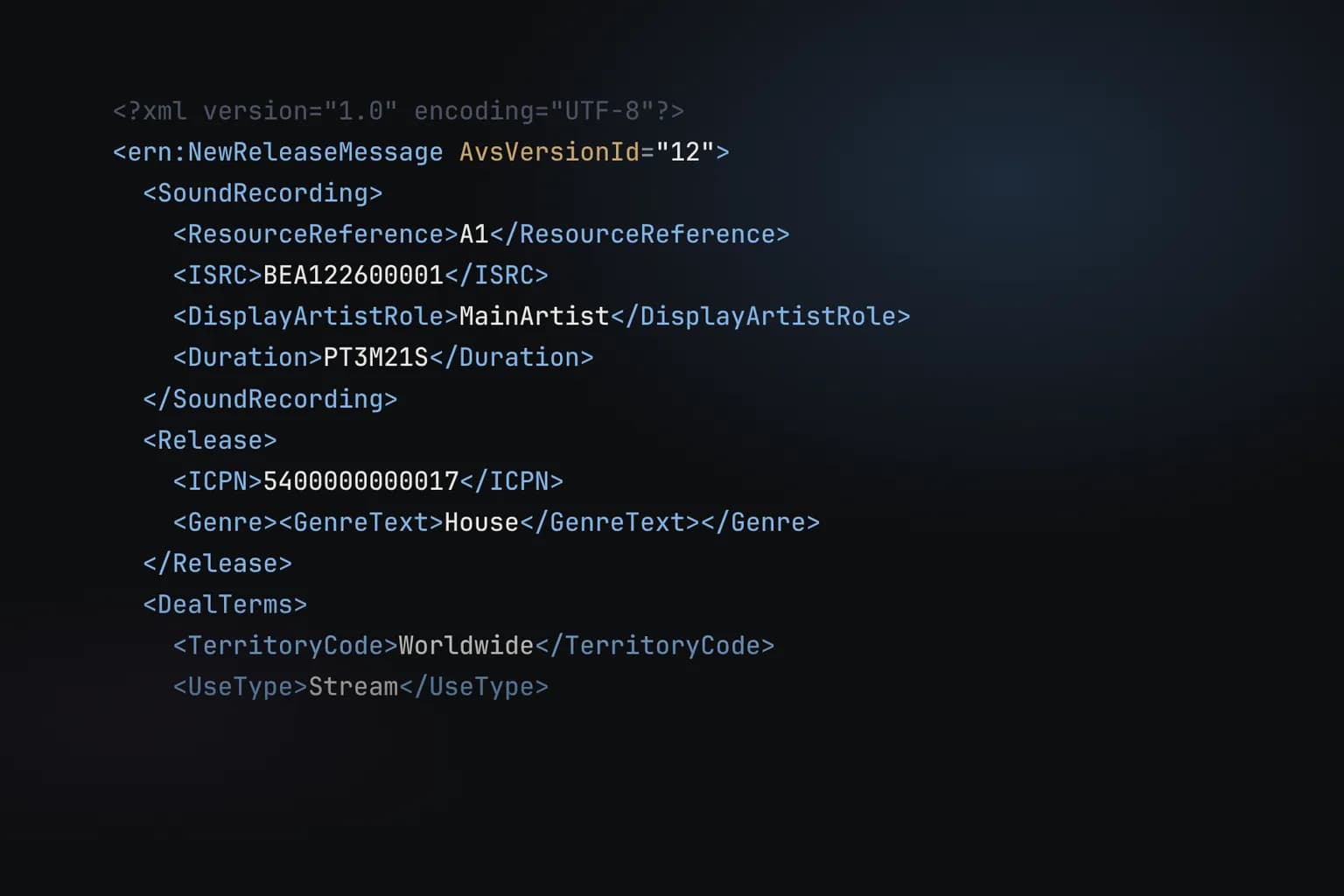
When you upload a release to your distributor, you fill in a form. Spotify, Apple Music and every other store never see that form. They receive a file called an ERN, and everything they show, sell and report comes from it.
If the ERN is wrong, the release is rejected, credited to the wrong person, or paid to nobody. Most of that is fixed before the file is ever written.
DDEX and ERN in one minute
DDEX (Digital Data Exchange) is the standards body labels, stores and collecting societies set up in 2006 so they could stop inventing a format per partner. It publishes XML formats for every step a recording takes.
ERN (Electronic Release Notification) is the one that goes out. It tells a store: here is a release, here are the recordings and the artwork in it, here is who made them, and here is where and how you may sell it.
| Standard | Direction | What it carries |
|---|---|---|
| ERN | Label to store | The release, its recordings, credits and deals |
| DSR | Store to label | Streams, downloads and money, per recording |
| MWN | Publisher to store | Songs (musical works) and their writers |
| MEAD | Label to store | Extra detail: moods, focus tracks, lyrics notes |
Your distributor sends the ERN for you. Labels with their own store deals send it themselves. Label accounting tools read it too: Qlero, for example, builds a label's catalogue from the ERNs its delivery partner sends in.
What is inside an ERN
An ERN 4 message has five parts, always in this order:
- Message header. Who sends it, who receives it, and a thread id that ties every later update to this release.
- Party list. Every artist, writer, producer and label, declared once and referred to by a short reference everywhere else.
- Resource list. The recordings, each with its ISRC, length, explicit flag and credits, plus the cover art.
- Release list. The product: its UPC, title, label, genre, release date and track order.
- Deal list. Where it may be sold, how (streaming, download, subscription, free with ads) and from which date.
Every code from ISRC, ISWC, IPI and UPC has a place in it. The ISRC names each recording, the UPC names the release, and IPI numbers identify the writers.
Why it matters
Rejections are almost always metadata
A store rarely refuses a release because of the music. It refuses a missing ISRC, a UPC with the wrong number of digits, a release with no genre, a featured artist in the main artist slot, or artwork that is not square. All of that is in the ERN or the files it points at, and all of it can be checked before anything leaves.
Credits decide who is paid
An ERN separates the artists a store displays from everyone else who worked on the record. A featured artist marked as featured shows as "feat." and gets their own artist page. A producer listed as a contributor stays a credit. Swap the two and the release reads wrong on every store at once.
Money comes back on the same codes
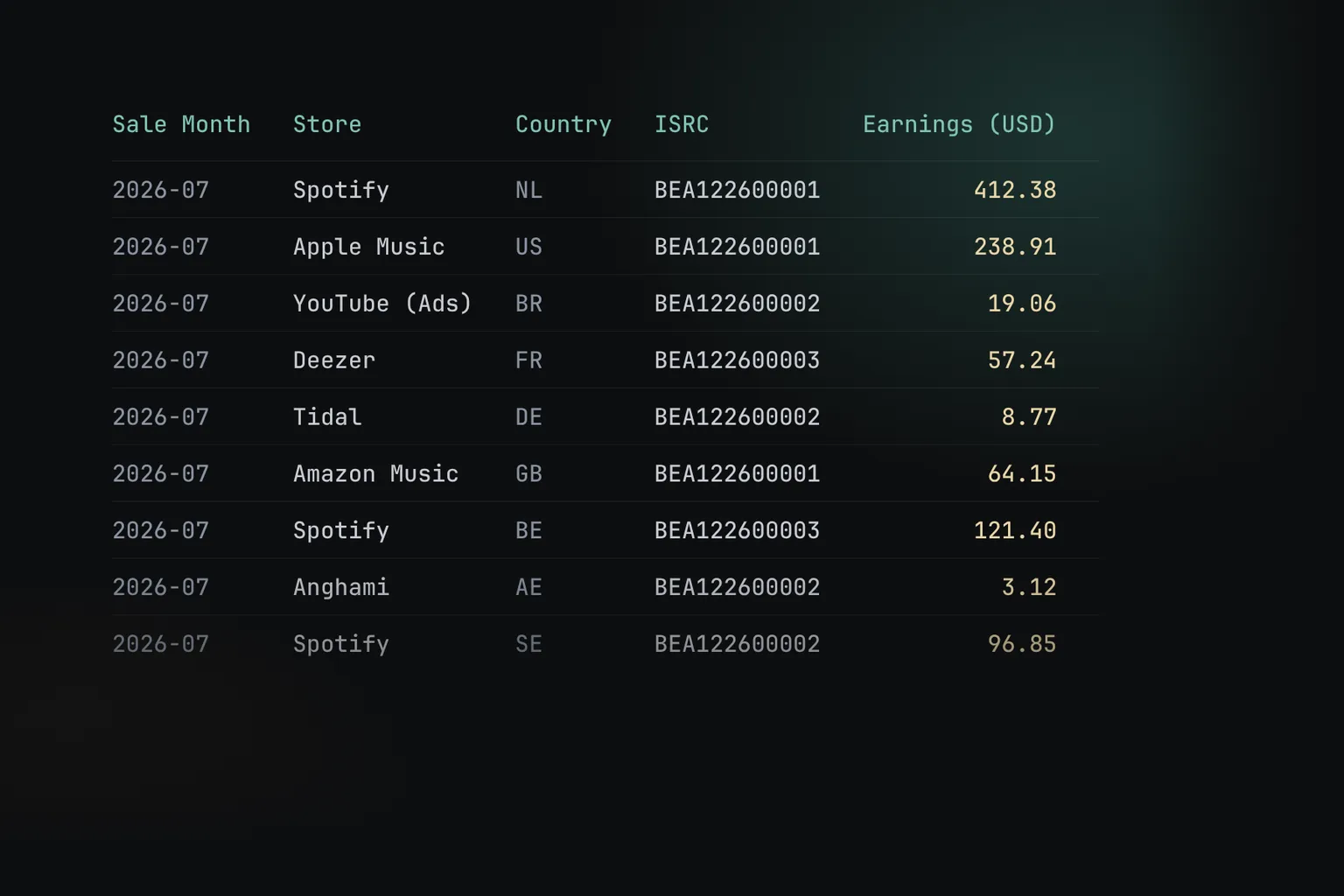
Stores report sales in a DSR (Digital Sales Report), keyed on the ISRCs and UPCs the ERN sent out. A label matches that report to its catalogue, and to the people it owes, by those codes. A typo in the ERN becomes income nobody can claim.
A release has a life after release day
The first ERN is a new release. Fixing a credit or adding territories sends another ERN on the same thread, which the store reads as an update. Taking a release down in ERN 4 is an update too: the same deal, with an end date at least two days in the past so no time zone still sees it live.
ERN 3 or ERN 4
Both are in use. Many stores and distributors still run ERN 3, while new integrations use ERN 4.
| ERN 3 | ERN 4 | |
|---|---|---|
| People | Names repeated inline | One party list, referenced by id |
| Takedown | A TakeDown flag on the deal | An ended deal |
| Updates | An update indicator | A new message on the same thread |
You never pick a version as an artist. Your distributor sends what each store accepts.
Who needs a DPID
Every company that exchanges DDEX files directly has a DPID (DDEX Party Identifier), issued free with the DDEX implementation licence. It goes in the message header.
An artist releasing through a distributor does not need one: the distributor's DPID goes on the message. A label needs its own once it delivers to stores directly.
How Aden supports it
Export for distributor. On a track's Release tab, Export for distributor downloads what a distributor needs: the master, the cover, release.xml (an ERN 4.3 new release message), a CSV with the fields upload forms ask for, and a README. The file follows DDEX's ERN 4.3 schema, down to how it credits main and featured artists, contributors and writers' IPI numbers.
Checks before export. The export only downloads once the release passes the checks a store would run: ISRC and UPC format, release date, genre, a primary artist, and writer and master splits that each add up to 100%. Each problem links to the screen that fixes it.
Checks on the files. When you ask an artist to deliver a release through a share link, Aden checks the cover before it uploads (size, squareness, colour mode, transparency) against Apple Music's spec, the strictest major store, and checks the master once it arrives.
One source for every way out. The same release data feeds the export, the CSV, and ChatGPT or Claude when you ask them to fill in your distributor's form for you. Fix a field once in Aden and every route reads the fix.
What Aden does not do yet: send ERNs to stores itself. Your distributor delivers the release. In a file you upload by hand the two party ids in the header are placeholders, because a hand upload is not a direct DDEX exchange.
FAQ
What does ERN stand for?
Electronic Release Notification. It is the DDEX standard a label or distributor uses to tell a store about a release: its recordings, artwork, credits, identifiers and the deals under which it may be sold.
Do I need a DPID to release music?
No. A DPID identifies a company that exchanges DDEX files directly with stores. When you release through a distributor, the distributor's DPID is on the message.
Can I upload an ERN to my distributor?
Some distributors import DDEX, often on label accounts. If yours has only an upload form, use the CSV from the same export: it lists the fields those forms ask for.
What is the difference between ERN and DSR?
An ERN goes out and describes what is for sale. A DSR comes back and reports what was streamed or sold, and what it earned, keyed on the same ISRCs and UPCs.
How do I take a release down?
Ask your distributor. In ERN 4 a takedown is sent as the same deal with an end date in the past, so the store removes it everywhere at once.
Does Aden deliver releases to Spotify or Apple Music?
Not directly. Aden prepares and checks the release and exports the files your distributor needs, including the ERN. It can publish straight to SoundCloud when your team has connected an account.
Less admin. More music.